Paint code unknown
Paint code unknown
¡Hola a todos los apasionados del Vocho en México!

Estamos realizando una investigación histórica para nuestro sitio web dedicado a la serie especial "Jeans". Como saben, México produjo versiones únicas y fascinantes en 1975 y 1976, como la famosa "Sport Jeans".
Desafortunadamente, la información oficial de la época es muy escasa. Por ello, solicitamos su ayuda para completar nuestra base de datos. Buscamos cualquier documento original o testimonio sobre los códigos de pintura exactos (Verde Manzana ?, naranja cítrico ?), números de chasis, fichas técnicas del motor 1600 con doble carburador Weber o fotos de folletos originales.
Si poseen un modelo original o tienen documentos históricos, su contribución sería invaluable para preservar la historia de estos Vochos tan especiales.
Pueden enviarnos cualquier información o ponerse en contacto con nosotros directamente a través de nuestra página de contacto. ¡Muchas gracias por su ayuda!
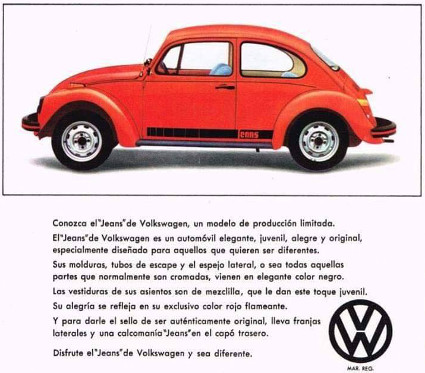
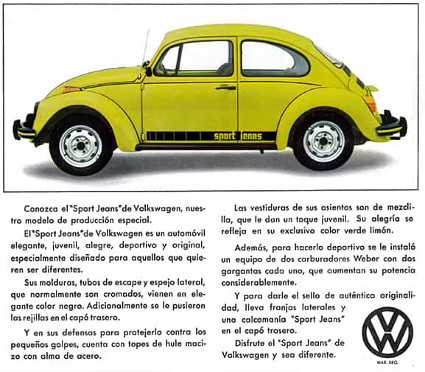
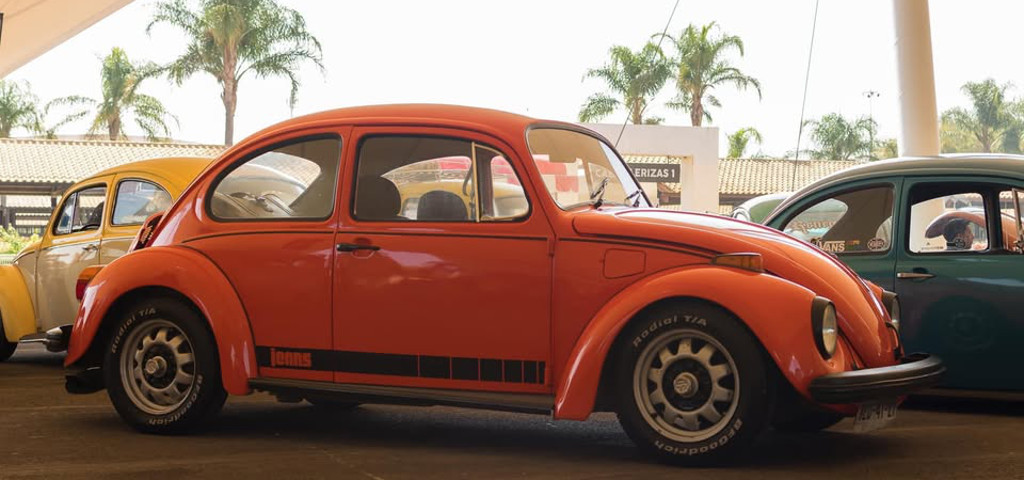
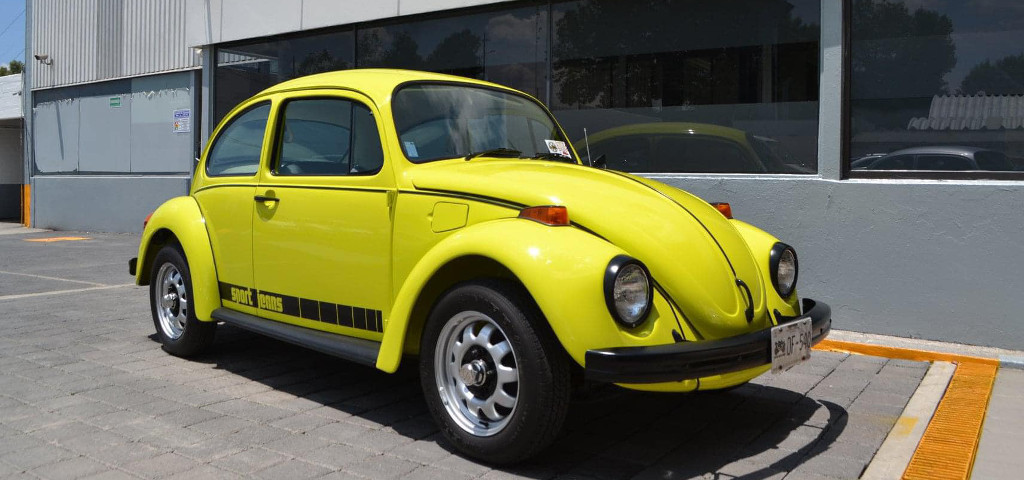
VW Mexico also produced its own Jeans model in 1975 and 1976. Two versions were available: the 1600cc "Jeans" in red, and the 1600cc "Sport Jeans" in yellow, equipped with dual twin-choke carburetors. Although the exact paint codes from the Puebla plant are not documented, period advertisements mention "Rojo Flameante" for the Jeans and "Verde Limón" for the Sport Jeans. However, these are likely marketing names rather than official color codes.
Like its European cousin, the Mexican Jeans is entirely de-chromed. The sides feature the same black adhesive stripe, sporting the "Jeans" logo on the 1600cc version and "Sport Jeans" on the dual-carb version. The rear decklid logos receive the same treatment. The bumpers feature a pinstripe matching the body color. The "Sport Jeans" includes a few extra accessories, such as bumper overriders and add-on grilles on the rear decklid.
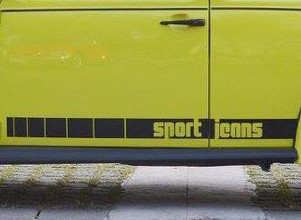
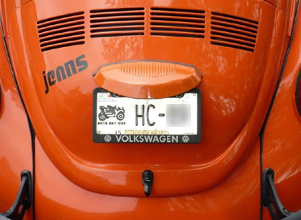
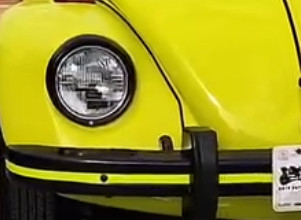
The upholstery is made of blue denim with yellow stitching. The dashboard is finished with black plastic trim. On the red Jeans models, the door panels appear to be black. No specific information is available regarding the Sport Jeans door panels. The headliner is a full-length model in white, as are the sun visors.
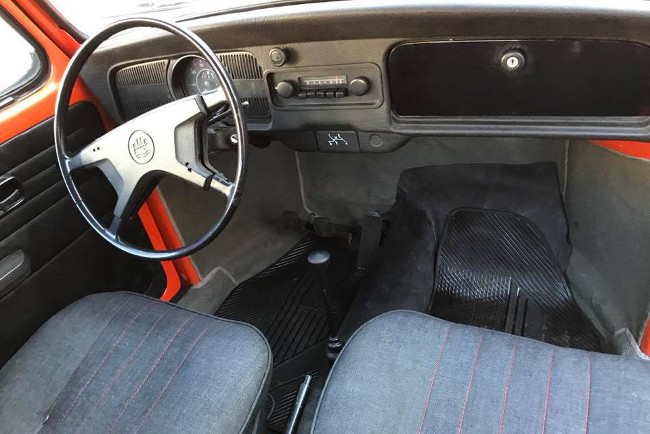
Thanks to a period invoice from a 1976 Jeans 1600 (single carburetor), we can accurately establish the list of standard equipment for the Mexican market. Despite being marketed as a "youthful" model, the 1976 Mexican Jeans did not sacrifice comfort. It was officially classified as a "Sedán de Lujo" (Luxury Sedan). Its features included notable safety and comfort items: a laminated windshield, a steering wheel with an integrated anti-theft lock, as well as finishing details like a passenger armrest and padded sun visors. It is also worth noting that the color listed on this document is "Rojo Jean's".
Special thanks to Arturo Navarro for the invoice of his 1976 Jeans.
While the comfort features of the Sport Jeans seem to mirror those of the standard 1600 version, it stands radically apart due to its engine preparation. The presence of additional instrumentation (tachometer, oil pressure, and temperature gauges) integrated into the dashboard vents is sometimes reported, although these items do not explicitly appear in the official technical descriptions of the time.
It appears that the "Weltmeister" (or World Champion) wheels, known as "Sport Jeans wheels" (Rines Sport Jeans) in Mexico, were offered as an option.
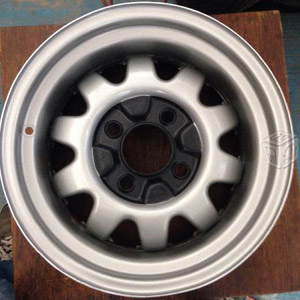
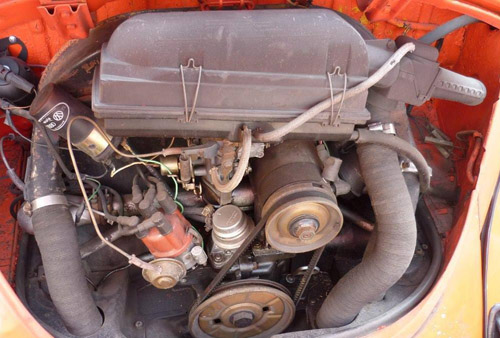
Two engine options were available: the 1600cc "Jeans", and the 1600cc "Sport Jeans" equipped with dual twin-choke Weber carburetors.
Jeans
Sport Jeans
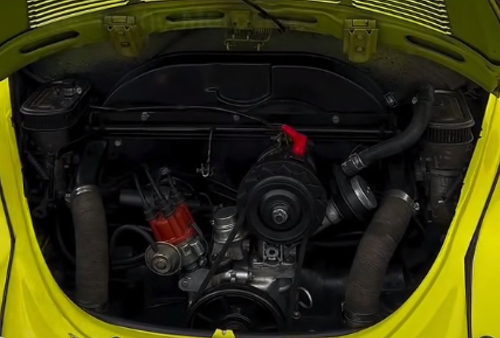
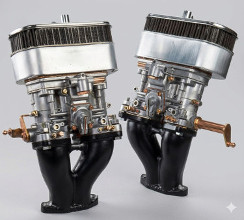
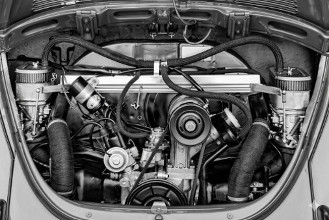
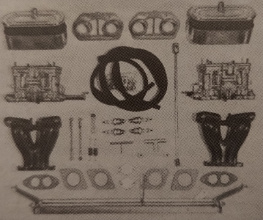
The most spectacular aspect of the Mexican Sport Jeans lies beneath the rear decklid. There, you find a dual Weber 40 IDF carburetor kit (sourced from Bologna). Technically, this setup is almost identical to the famous "Svelto" kit developed in the early 1970s by Autogerma, the official Volkswagen importer in Italy. The resemblance is striking: the intake manifolds, the air filters, and the throttle linkage are identical in every way to those used on the Italian kit.
Special thanks to Jorge Armadog, Arturo Navarro, Alfredo Acevedo, Clement Artura Sanchez Perez, Jorge Sepulveda, Sergio Priego, and Colin Shinkin (www.sebeetles.com) for providing information on this Mexican model.